


Most owners I talk to have already seen the demos. The slick video, the assistant that books the meeting and writes the email and orders the coffee. It’s impressive, and it’s almost no help when you’re trying to work out what to do on Monday morning.
So let me give you the question I actually use.
Not “what can AI do?” — “what do we keep redoing?”
The best first AI project in a business is rarely exciting. It’s the job nobody enjoys, that happens often, that follows a rough pattern, and that doesn’t need to be perfect — just consistent. That’s the sweet spot.
Look for work that ticks these boxes:
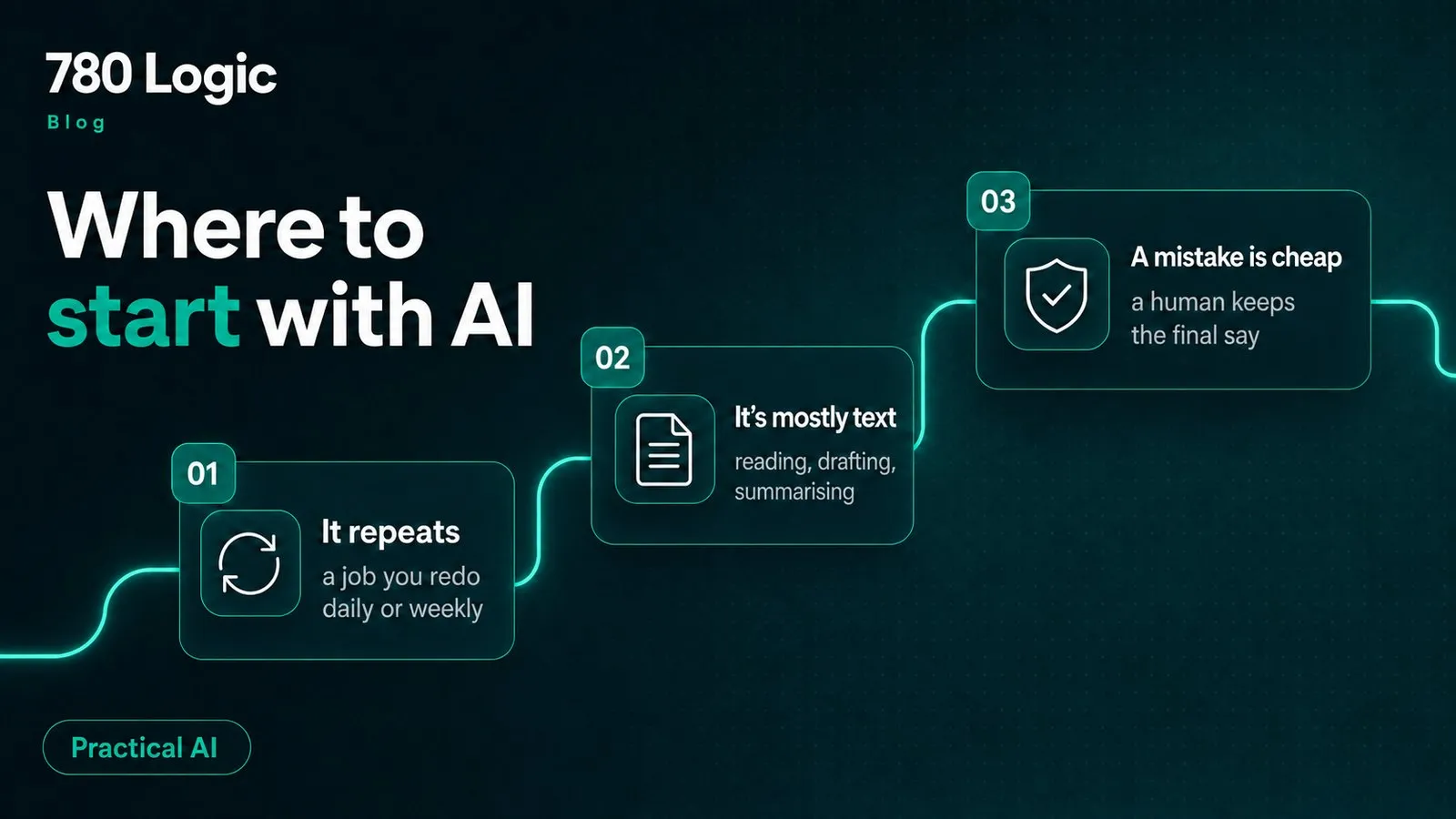
- It repeats. Daily, weekly, every time a new customer comes in.
- It’s mostly text. Reading, sorting, summarising, drafting, replying.
- A good-enough answer is genuinely useful. A human still has the final say.
- Someone quietly hates doing it. That’s your strongest signal.
Quoting from messy email threads. Turning a phone call into notes. Triaging the inbox. Pulling the same five fields out of supplier PDFs. Writing the first draft of something that always starts from a blank page. None of it is glamorous. All of it gives time back.
Start where a mistake is cheap
Early on, you want jobs where a wrong answer costs a few seconds to catch, not a customer. A first draft you’ll edit anyway is perfect. A figure that goes straight onto an invoice is not — at least, not yet. Earn that trust in stages.
The goal of a first AI project isn’t to be impressive. It’s to be boring, reliable, and quietly useful — so the people doing the work stop fighting it and start leaning on it.
A small, honest first step
Pick one repeated task this week. Write down how you’d explain it to a new starter — the inputs, the steps, what “good” looks like. That plain-English description is 80% of the work. Most “AI projects” are really just clear thinking written down, with a model doing the typing.
If you can describe the job well, you can usually automate the dull part of it. If you can’t describe it well, no amount of AI will save you — and that’s worth knowing too.
That’s where I’d start. Not with the tool. With the task.