


People tell me AI “didn’t really work” for them, and nine times out of ten they did exactly what the tool invites you to do: typed one line, hit enter, read the first answer, and decided. One pass. One shot. Done.
That’s not how you’d brief a person, and it’s not how to get good work out of a model either.
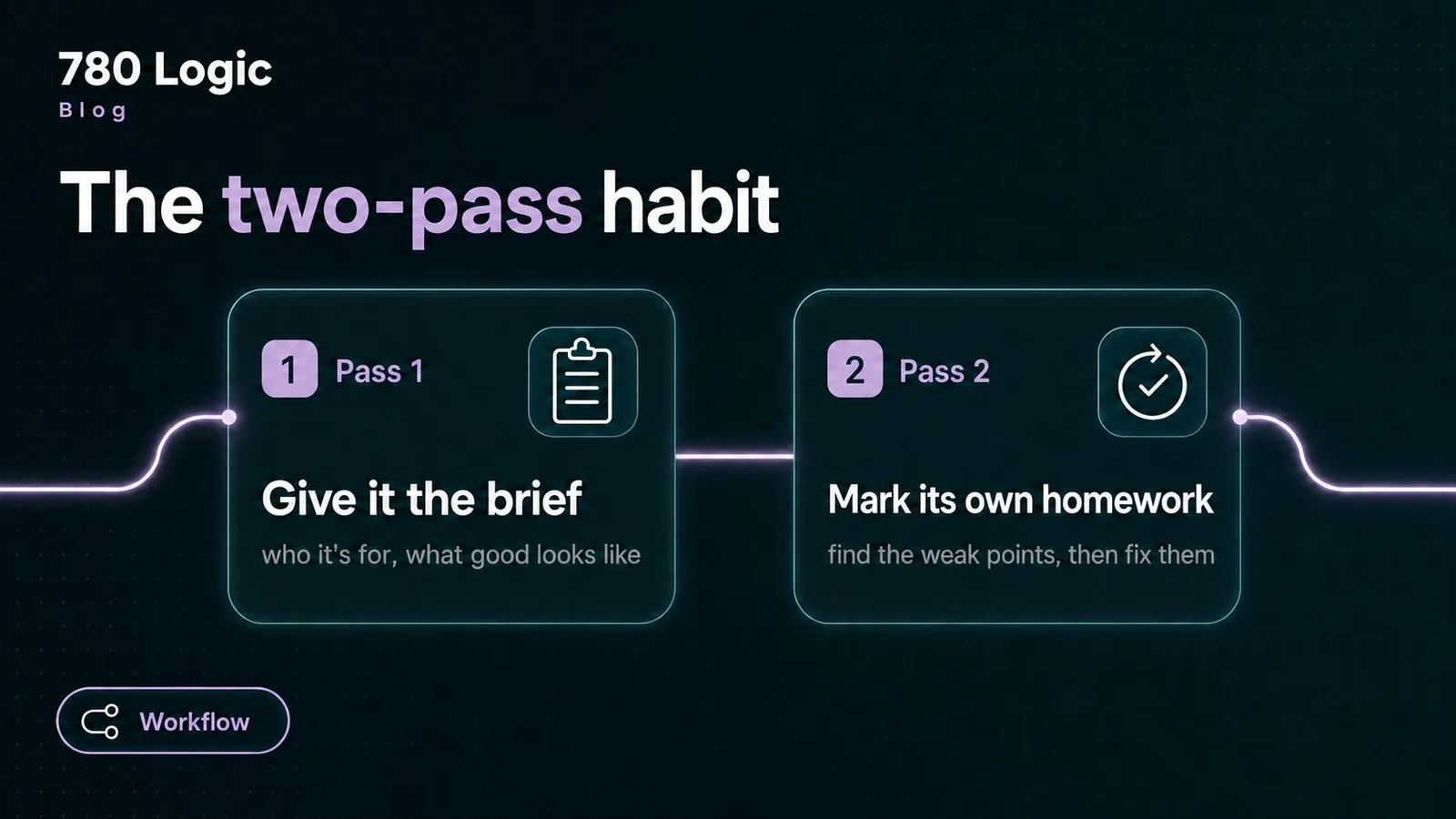
The two-pass habit
Pass one is for direction. Pass two is for quality. Splitting them is the single biggest upgrade most people can make, and it costs nothing.
Pass one: give it the brief, not just the task
A one-line prompt gets a one-line-quality answer. Spend thirty seconds adding the things you’d tell a freelancer:
- Who it’s for. “A customer who’s annoyed,” “a busy accountant,” “my mum.”
- What good looks like. Length, tone, format. “Three bullets, plain English, no jargon.”
- What to avoid. “Don’t promise a refund,” “don’t guess the price.”
- The real context. Paste the actual email, the actual numbers, the actual notes.
You’re not writing a clever prompt. You’re just refusing to make the model guess.
Pass two: make it mark its own homework
Here’s the part almost nobody does. Take the first answer and push back:
“That’s a decent start. Now find the three weakest points in it, and fix them. Be honest about anything you’re unsure of.”
The second pass is where mediocre becomes usable. The model is often perfectly capable of better work — it just gave you the first thing that came to mind, the same way a person would if you rushed them.
Why this matters more than the tool
I get asked which model to use far more than I get asked how to use it well. Honestly, the gap between a good prompt and a lazy one is bigger than the gap between most models. A clear brief and one round of “make this better” will beat a fancier tool used carelessly almost every time.
Treat it like a capable, slightly over-eager colleague: brief it properly, then ask it to check its own work. Two passes. That’s the whole trick.