

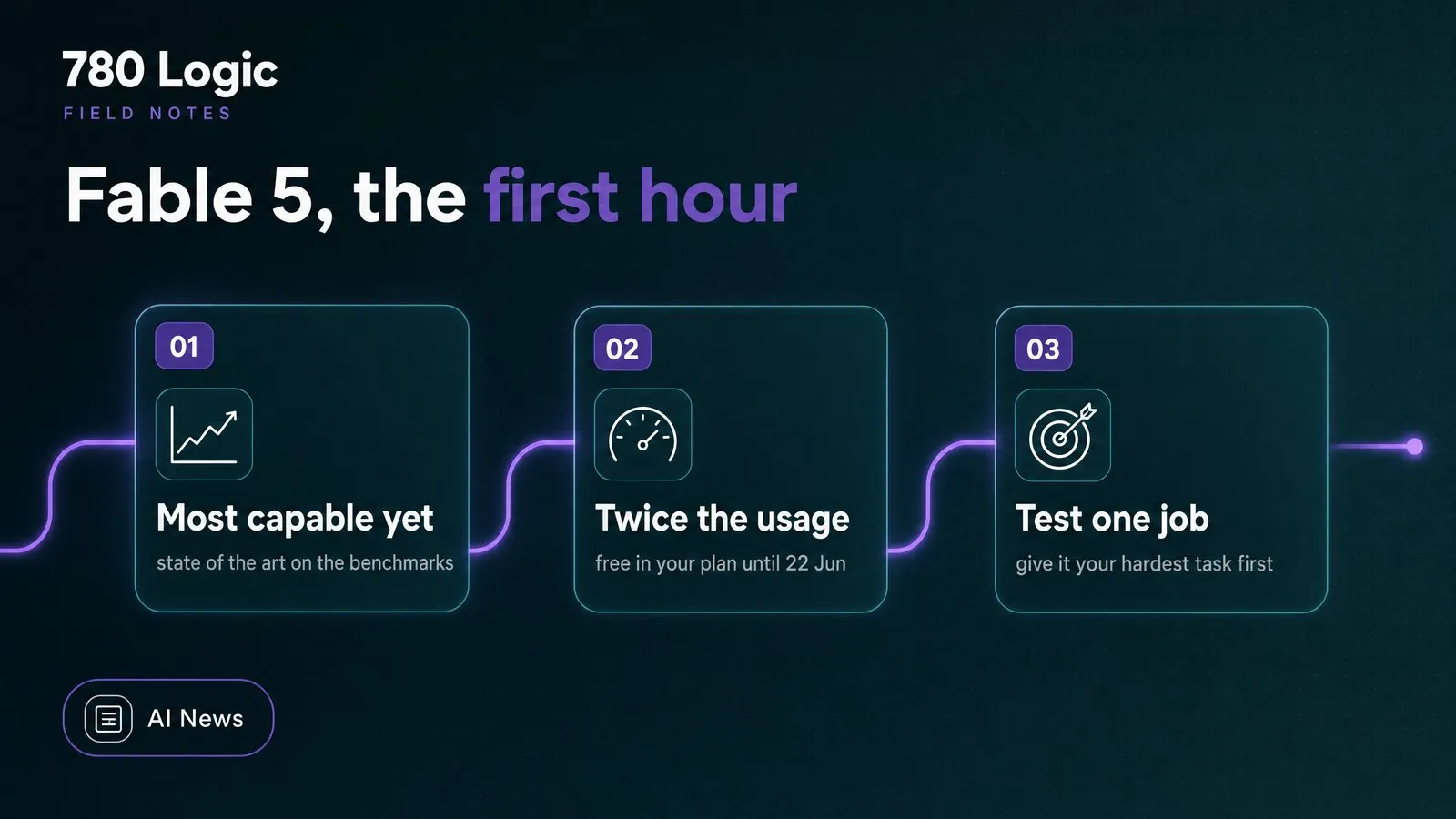
A box slid into the corner of my Claude app this morning: “Fable 5 — our most capable model yet. Try Fable 5.” So I did, and I’m writing this within the hour, while the first impression is still honest.
Here’s the calm read for a busy owner, because the headlines are about to get very loud.
What actually landed
Anthropic released two things today. Fable 5 is the one you can use — their most capable model so far, now in the Claude app and the API. Mythos 5 is the same model with some of the guardrails lifted, kept back for a small set of cyber-defence and research partners. Interesting, but not your concern.
The benchmark claims are genuinely big: state of the art on nearly everything they tested, and Stripe says it ran a code migration in a day that would normally take two months. Impressive — and, for most owner-led businesses, beside the point. You’re not running a 50-million-line codebase. The useful question is quieter: does it do your awkward jobs with less babysitting?
What’s actually relevant to you
The line that matters is the small one under the title: tackles your biggest challenges with fewer check-ins needed. In plain terms, it’s better at long, multi-step work — the kind where the old model needed you to nudge it three times. If you’ve got a task that’s been just slightly too tangled to hand over — reconciling a messy spreadsheet, drafting a proper proposal from scattered notes, working through a fiddly policy — that’s where to point it first.
Two practical notes before you lean on it:
- It’s free in your plan until 22 June, then it costs more. Fable uses about twice the usage of Opus, so it’ll work through your plan limits roughly twice as fast, and after the 22nd it draws on usage credits. Treat it as the tool you reach for on the hard jobs, not your everyday default.
- There’s a safety switch. When something trips its safeguards — cybersecurity, biology, that sort of thing — it quietly hands the conversation back to the older Opus model. Anthropic says that happens in under 5% of sessions, and for ordinary business work you’ll likely never see it. The default is sensible; leave it on.
How I’d actually try it
Don’t switch your defaults on day one. Take the single job your current AI keeps almost getting right, give it to Fable 5, and see whether “fewer check-ins” is true for your work — not for Stripe’s.
That’s what I’m doing now: feeding it the one task I’d half given up on automating, and watching how much hand-holding it still needs. If it clears that bar, it earns a place. If it doesn’t, the older model is still right there, and I’ve lost ten minutes.
A new “most capable model” arrives every few months now. The skill isn’t chasing each one — it’s having one honest job ready to test them against. I’ll report back once I’ve run mine through a proper week.