


You’ve probably heard the phrase “second brain” by now. It’s having a moment — apps, gurus, productivity videos. And like most things having a moment, it arrives wrapped in enough jargon to put any sensible business owner straight off.
So let me strip it back. A second brain is just a place outside your head where your business keeps what it knows — and, crucially, where you can find it again.
That’s the whole idea. You don’t need an app to understand it.
Why “outside your head” is the point
In my last note I made the case that your business already has a memory — it’s just scattered across your inbox, a notebook, a few voice notes, and mostly your own head. The trouble with “in your head” is that it doesn’t search, it doesn’t share, and it walks out the door when you do.
A second brain fixes the location problem first. One place. Everything lands there — the supplier quirk, the half-formed idea, the answer you worked out once and never want to work out again.
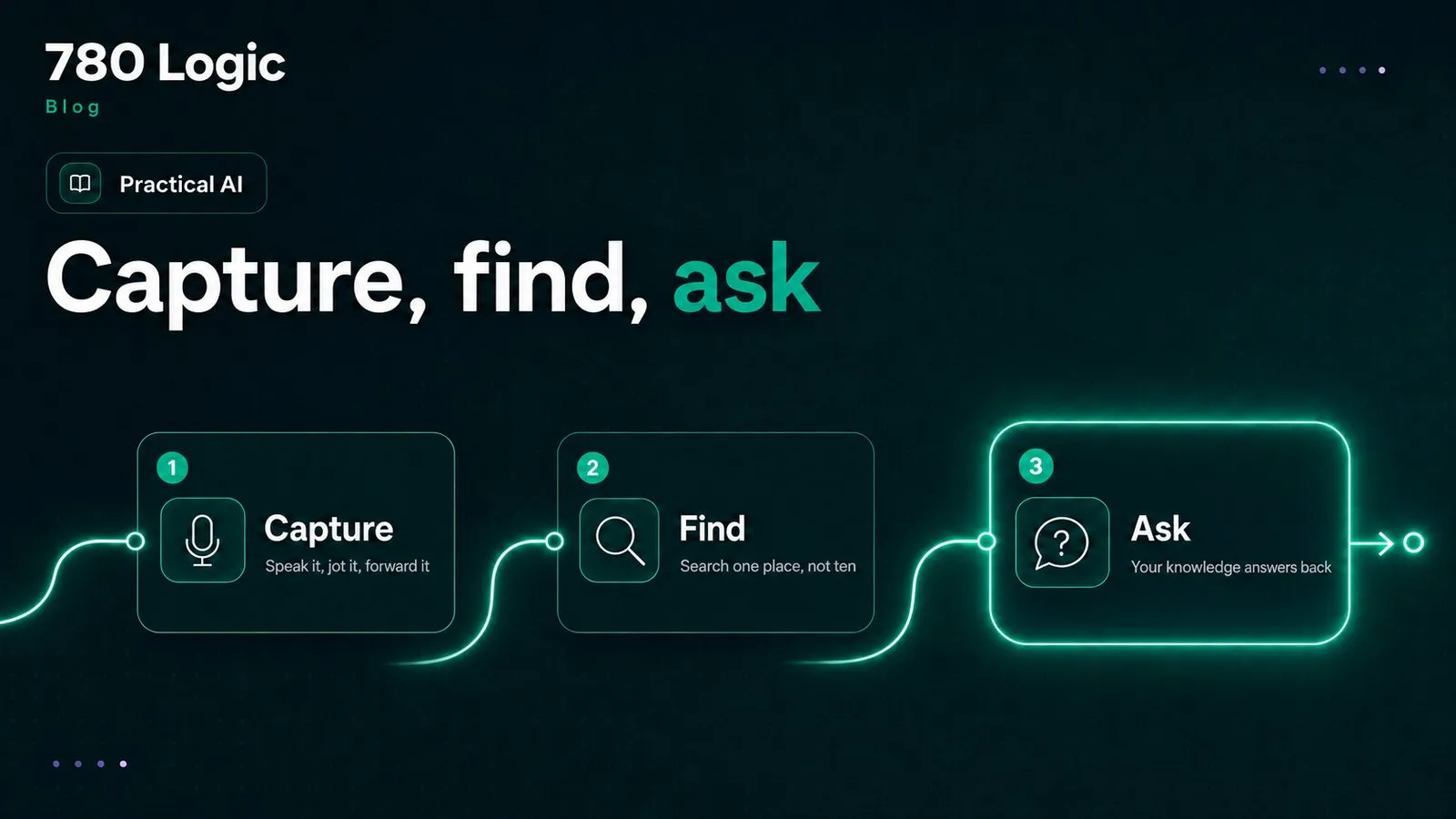
Capture, find, ask
Three things make it actually useful, in order of how much they change your week.
Capture. It has to be effortless or it won’t happen. Speak a voice note, forward an email, snap a photo of a scribbled list. If capturing takes more than a few seconds you’ll stop doing it, and a second brain you don’t feed is just an empty folder.
Find. This is the bit that earns its keep. Instead of “which app did I put that in?”, you search one place and the answer surfaces. Six months on, you can still find what you decided about that customer.
Ask. This is the main place AI earns its keep. Once your own information is in one place, you can ask it questions in plain English. “What did we agree on pricing for trade customers?” “Pull out everything that supplier has ever told us about lead times.” It isn’t magic. It’s your own knowledge, finally able to answer back.
A second brain isn’t really about AI. It’s about getting your business’s knowledge out of your head and somewhere it can work for you. AI is just what makes it answer back.
Keep your eyes on the business, not the tool
Here’s the part the productivity videos skip. The goal is not to build a beautiful system you then have to tend like a garden. If you’re spending your evenings organising your second brain, it has failed.
The point is the opposite: spend less time remembering, chasing and finding things again, so you can spend more on the actual business. Good tools disappear. You shouldn’t feel them. You should just notice, one ordinary Tuesday, that you’ve stopped losing things.
Where to start
Don’t buy anything yet. For one week, pick a single bucket — everything to do with one supplier, say, or one decision you keep revisiting — and put it all in one place. Notes, emails, the lot.
At the end of the week, ask yourself one question: was it easier to find what I needed? If the answer’s yes, you’ve felt the whole idea in miniature. The rest is just doing that for more of the business — and that part, I can help with.